“This was undoubtedly composed in Greek, with the exception of the work of Matthew the Apostle, who was the first to commit to writing the Gospel of Christ, and who published his work in Judaea in Hebrew characters. We must confess that as we have it in our language it is marked by discrepancies, and now that the stream is distributed into different channels we must go back to the fountainhead.”
Letter addressed to Pope Damasus, A.D. 383
F. F. Bruce, The Canon of Scripture, 87-89.
360s: Educated in Rome
374 Begins Hebrew study
379 Ordained presbyter
381 Studies in Constantinople
382 works with Pope Damasus
383 Works on the Latin Bible
385 Leave’s Rome after Damasus’s death
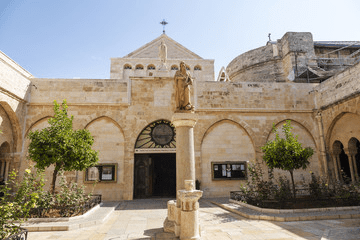
386 Settles in Bethlehem
390-405 Translates the Old Testament
420 Dies in Bethlehem
Have you ever had difficulty figuring out what English translation of the Bible is the “right” one? If you were anything like me, it was all confusing. New to the Christian faith, I got lost in the many translations. From the King James, to the New American Standard, to the English Standard, and on and on. Through much study, I found that to find a credible Bible translation, it is good to go to the roots.
“The labour is one of love, but at the same time both perilous and presumptuous”
Jerome. Nicene And Post-Nicene Fathers, First Series, vol. 6: St. Jerome: Letters And Select Works. Edited by Philip Schaff and Henry Wace. Translated by W.H. Fremantle, G. Lewis, and W.G. Martley. New York: Christian Literature Publishing Co., 1893. Accessed July 19, 2026. https://www.ccel.org/ccel/schaff/npnf206.vii.ii.viii.html
Latin name Eusebius Sofronius Hieronymus
Born 347 at Stridon in Dalmatia
Died 420 in Bethlehem
F. F. Bruce, The Canon of Scripture, 86-87.
Legacy: Biblical scholarship, specifically Latin translation: Latin Vulgate
Languages known: Latin, Greek, and Hebrew
Bruce Metzger, The Bible in Translation, 30-31.
“A Trilingual Man”
Jaroslav Pelikan, The Christian Tradition, 21.
Education
“to devote himself to biblical, no longer to secular literature.”
F.F. Bruce, The Canon of Scripture, 88.
His parents, when Jerome was in his teens, sent him to Rome to continue his classical education. Jerome was enrolled in the school of Donatus, a “celebrated grammarians of his day,”(F.F. Bruce, The Canon of Scripture, 87-88). Around the time of 374, others may have accused Jerome of “being a Ciceronian rather than a Christian.” This simply meant that Jerome, in his education, focused more on secular or non-religious works. So, what changed? How is Jerome now known for his biblical studies and translational work? It was due to a strong illness around this time, that almost took Jerome’s life, when he redirected his studies to focus on biblical works, (F.F. Bruce, The Canon of Scripture, 86-87).
Translational Work
“Augustine lamented, “Thosw who translated the Scriptures from Hebrew into Greek can be counted, but the Latin translators are out of all number. For in the early days of the faith, everyone who happened to gain possession of a Greek manuscript [of the New Testament] and thought he had any facility in both languages, howver slight that might have been, attempted to make a translation.”
Bruce Metzger, The Bible in Translation, 29.
It is easy to take for granted the works we have today. Bible translations are readily available in bookstores, online, phone Apps, and more. First, to be grateful for a major work that influenced the Western English Bible, one should ask why this work started. Just like today, with the many English translations that leave people lost, so there were too many Latin translations with differences (such as wording) or too literal that Jerome did not agree with, (Bruce Metzger, The Bible in Translation, 29-30). Jerome was not the first to make a Latin trnalsation of the Bible, he simply edited using non-traditional works, to create a more standard Latin Bible.
Jerome did not get unconditional support to do the work he set out to do. He had critics. The Septuagint had been the version people relied on for approximately 600 years. Jerome, although he did use this work in his initial translation, such as Psalms, he did not use it for the majority of his translational work, (Bruce Metzger, The Bible in Translation, 31). This move away from traditional methods is what led Jerome to receive criticism from other Christians. During this time, the Hebrew language was not very well known to scholars. However, Jerome rises above this challenge and seeks out instruction to learn the Hebrew language. Jerome’s use of the Hebrew texts could be seen as moving away what many considered as the inspired word of God, the Septuagint, (F.F. Bruce, The Canon of Scripture, 88-89).
Conclusion: Questions to ask yourself.
Throughout history, many projects have birthed from what people thought were good ideas. What do you think? Was Jerome’s heart in the right place, to want a more substansive and less confusing Latin Bible? Was his method, going to the Jewish texts rather than using the Greek, a smart move on his part? After asking yourself these historical questions, one can make this more personal. Have you benefited from having a Bible in your own language or know someone who has? You can also create hypotheticals, like what would life be like if the west did not have the Bible in their own language? Would anything be different? If so, what?
These questions, whether historical, speculative, or hypothetical, allow those who live in the present, to engage with the past. The past is not a dead thing that serves no purpose, but an alive account of real people, with real stories that has, whether we admit it or not, had impact on our lives in some way. Jerome’s work on the Bible has impacted the west in such a way that history classes must discuss him. Theology courses must place him as a turning point figure in chuch history. The average person in the west must, as one goes from home to home, hotel to hotel, bookstore to bookstore, think of Jerome when they see a Bible.
Bibliography
Jerome. Nicene And Post-Nicene Fathers, First Series, vol. 6: St. Jerome: Letters And Select Works. Edited by Philip Schaff and Henry Wace. Translated by W.H. Fremantle, G. Lewis, and W.G. Martley. New York: Christian Literature Publishing Co., 1893. Accessed July 19, 2026. https://www.ccel.org/ccel/schaff/npnf206.vii.ii.viii.html
Specific source will be: Jerome, Letter 57, “To Pammachius on the Best Method of Translating.”
Bruce, F.F. The Canon Of Scripture. Downers Grove, IL: InterVarsity, 1988.
Metzger, Bruce M. The Bible In Translation: Ancient And English Versions. Grand Rapids, MI: Baker Academic, 2001.
Pelikan, Jaroslav. The Christian Tradition: A History Of The Development Of Doctrine. Vol. 1. Chicago: University of Chicago Press, 1971.





Leave a Reply