What if religious authority is wrong?
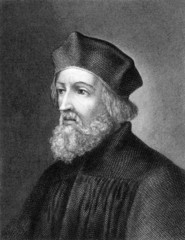
Born: 1372-73, Husinec, souther Bohemia
Education: University of Prague
Occupation: University master, priest, preacher
Legacy: Depating against ecclesiastical authority abuse
Major Work: De Ecclesia
Died: July 6th, 1415, in Constance
Matthew Spinka, Jan Hus, A Biography, 21.
Religious Authroity

You go through the wooden door, come to the large room filled with pews. As you slowly walk down the isle, you notice some praying, some grieving, some listening intently to the man on an elevated stage. As you take your seat, you notice that the only one who seems to be reading from any book is the man preaching. After some time, you tune in to the words being spoken. What is being preached seems to have eternal consequences. Your heart is stirred but the next thought scares you even more. Is this true? For if it is, how can you be sure? Does this man on the elevated platform deserve your entire trust that what he said is true, even if your soul depends on it? Let us explore a man who ventured through the wilderness to seek these truths.
Upbringings
“I confess to have entertained an evil desire, for i had thought to become a priest quickly in order to secure a good livelihood and dress well and to be held in esteem of man.”
(Matthew Spika, Jan Hus, A Biography, 28).

His birthplace, unremarkable, to which one author says, “Can any good thing come out of Husinec,” (Matthew Spika, Jan Hus, A Biography, 21). His birth record is not assured, as there were no parish registers in this town, (Matthew Spinka, Jan Hus, A Biography, 21). How can a man, whom we know only his father’s name, Michael, no name for a mother, a brother who is also unnamed and unknown whether he is older or younger than Hus, (Matthew Spinka, Jan Hus, A Biography, 21), be so important for the average person today? How did he become known? His education is well accounted for, having been educated in Latin, German, arithmetic, grammar, astronomy, and much more helped him become a learned man despite his poor upbringing. His continued education, luck may have it, was due to Emperor Charles IV, who established the University of Prague in hopes that those who “beg for alms” would not need to do so, since they so longed to learn, (Matthew Spika, Jan Hus, A Biography, 25).
Finally, A Priest
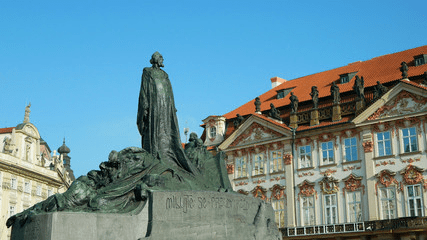
Appointed as preacher at a local chapel in Bethlehem in 1403, who would have thought that, due to his preachings, this chapel would become the center of a national movement? Preaching style, whether direct or indirect, engaging or not was not what caused so much attention. His sermons on the abuse of God’s word by the clergy is what grabbed the attention of many, (John Huss, De ecclesiastical, viii). As many historical figures histories bare out, when one speaks up against the accepted norm, tragedy is soon to follow, but first, let me briefly show how this movement took shape.
1384: Spreading of Wycliffe’s views.
1384: Wycliffe dies, teaching declared heretical by Gregory XI.
1409: Huss’ character in violent controversy, Germans disdain him
1410, against Hus’s objections, archbishop of Prague, Zbynek, burned 200 writings of Wycliffe.
1412: Huss attacks the sell of indulgences authorized by John XXIII
What does the Bible say?
“And I also say to you that you are Peter, and upon this rock I will build My church; and the gates of Hades will not overpower it.”
Legacy Standard Bible

Jan Hus wanted to bring people back to what the Scriptures state, not just what clergy say. For Jan to be successful in persuading the people, he focused on one of the most damning verses the Catholic church relied on, Matthew 16:18. Hus start at the end and works his way backwards, so that people can see the flaw behind the Pope being the foundation of the church. The passage states Peter’s name, the addressed person. Who is addressing him is Jesus. The Catholic church focused too much on who was being addressed over the one who was speaking. The Catholic Church, thus, emphasized Peter as the builder of the church, rather than the one who said, “I will build,” (Jan Huss, De Ecclesia, 73). It is Jesus who establishes the church, not Peter. Hus wants to show others that clergy is flawed and human, just as Peter was, yet God can use us for His purposes. Too many people blindly followed the words of the church that they were unwilling to think if the church, led by man, could be wrong.
Jan Hus’s Fate: July 6th, 1415
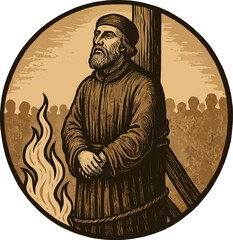
Jan Hus was eventually martryed for his convictions, but he would not be the only one. Historians view John Wycliffe (suffered similarly as Jan Hus) and Jan Hus as branches that lead to the same root, culminating in Martin Luther and the Protestant Reformation. We can be reminded of the Reformation everytime we are able to pick up a Bible in the translation of our choosing, but the costs the Catholic Church warned about can still be felt. The Church’s fear of Wycliffe, Hus, and Luther’s goal for Biblical transpararency for the common pew attendee was the uncertainty that the common people, like you or I, would be able to interpret God’s word and the most vital message in all of human history without error. This fear is realized today. Go to a local bookstore and look at the different translations. The very benefit that we get to choose also produces a doubt and a crippling fear for those who wonder which translation holds the truth for my soul.
Questions for Reflection
The Catholic Church’s desire for true Biblical hermenutics was genuine and important, but the abuse of the church was also real. How do you think the Church could have allowed people to read God’s word for themselves, while also guiding people to not misinterpret the very message they were reading? For today, with all the translations out there, should there be an ecclesiastical authority in charge of the making and distrubution of authorized translations or do you think anyone should be able to translate the Bible? Why or why not?
Bibliography
- Hus, Jan. De Ecclesia (The Church). Translated by David S. Schaff. New York: Charles Scribner’s Sons, 1915.
- Fudge, Thomas A. Jan Hus: Religious Reform And Social Revolution In Bohemia. London: I.B. Tauris, 2010.
- Kaminsky, Howard. A History Of The Hussite Revolution. Berkeley: University of California Press, 1967.
- Spinka, Matthew. John Hus: A Biography. Princeton, NJ: Princeton University Press, 1968.


Leave a Reply